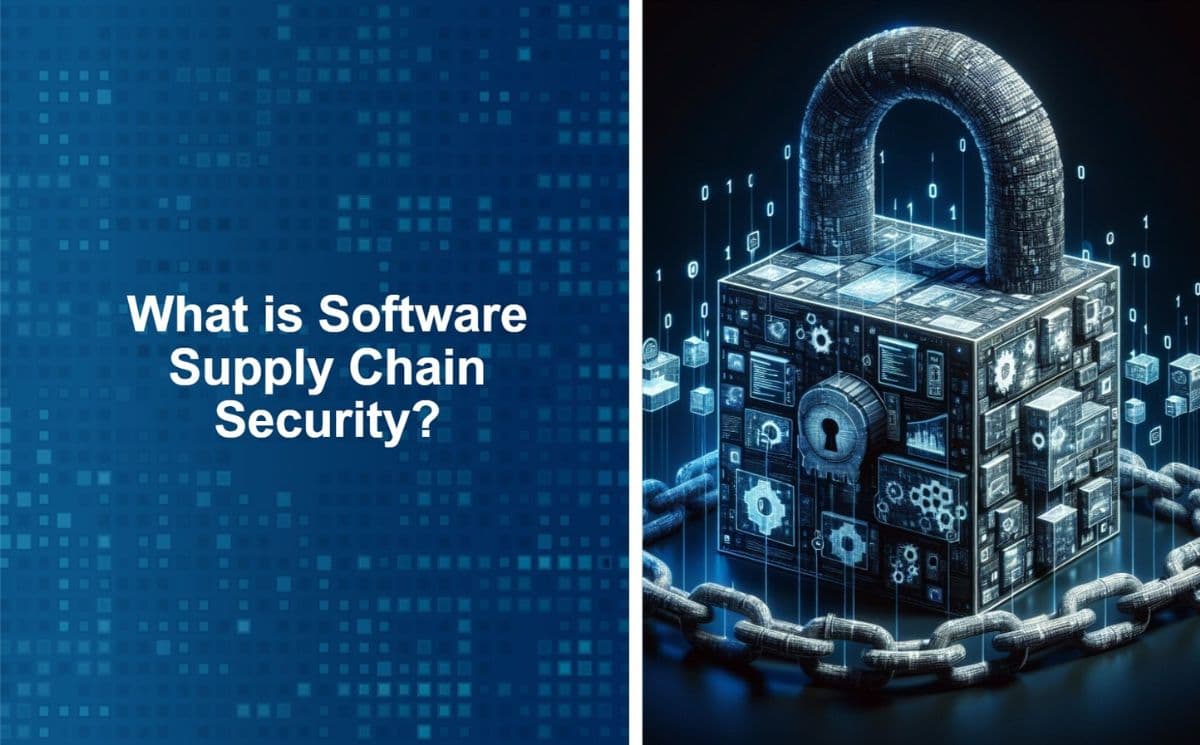
Software supply chain security is the practice of protecting every component, tool, and process that goes into building and shipping software, from open-source packages and third-party libraries to the build systems that assemble them into a finished product. Modern applications are assembled far more than they’re written from scratch, and each borrowed piece carries the trust and the risk of whoever produced it. Securing that chain means verifying what goes into your software and controlling how it gets built, so that a compromise upstream doesn’t become a compromise in what you ship.
What is the Software Supply Chain?
The software supply chain is the full set of people, code, tools, and infrastructure involved in producing a piece of software. It includes all the source code in your product, whether your team wrote it or pulled it in from somewhere else.
A typical application pulls in hundreds or thousands of open-source dependencies, along with container base images, package registries, build scripts, CI/CD platforms, and the credentials that tie everything together. The Linux Foundation’s Census II of open-source software estimates that free and open-source code makes up 70% to 90% of any modern application, so the average product inherits code from external maintainers around the world. When developers commit code, a continuous integration and continuous delivery (CI/CD) pipeline fetches those dependencies, compiles the code, runs tests, and packages the result. The pipeline is where every separate part converges into a single artifact that gets released to customers or deployed internally.
How Does Software Supply Chain Security Work?
Software supply chain security works by applying a set of controls that keep malicious or vulnerable components out of your software as it moves from source code to a deployable artifact. The goal is straightforward. You want assurance that what you ship contains only the code you intended, sourced from places you trust, assembled in a way you can verify.
Achieving that assurance covers several fronts. Teams manage the risk of open-source dependencies, verify the provenance of the components they consume, protect the secrets and signing keys used during builds, and produce evidence such as a software bill of materials (SBOM) to document each release. Frameworks like the NIST Secure Software Development Framework (SSDF) and the Supply-chain Levels for Software Artifacts (SLSA) give organizations a common language for these controls and a way to measure maturity.
Why Software Supply Chain Security Matters to CEOs and CIOs
Supply chain risk has moved from a developer concern to a board-level one, because a single compromised dependency can now expose an entire customer base. The 2026 Verizon Data Breach Investigations Report found that third-party involvement in breaches reached 48%, up 60% from 2025, one of the most significant shifts in this year’s report.
Financial Exposure
A supply chain compromise is expensive and slow to recover from. The 2026 IBM Cost of a Data Breach Report put the average cost of a supply chain breach near $4.96 million and found it took 258 days to identify and contain, tied with removable-media attacks for the longest-running of any initial attack vector tracked. The damage rarely stops at cleanup cost and extends into lost deals, customer churn, and fallout across every downstream party that trusted your software.
Regulatory and Contractual Pressure
Buyers and regulators now ask hard questions about how software is built. Government agencies, medical device makers, financial institutions, and critical infrastructure operators face growing requirements to document secure development practices and provide attestation. Failing to meet them can close off entire markets, and in some cases, the required attestations reach named executives or their designees.
Brand and Customer Trust
When your software becomes the delivery mechanism for an attack on your customers, the reputational cost outlasts the technical cleanup. Enterprise buyers increasingly treat supply chain assurance as a purchasing criterion, so demonstrable security has become a competitive advantage rather than a cost center.
How Software Supply Chain Attacks Actually Happen
Most software supply chain attacks work by compromising a trusted input so that the malicious code travels downstream automatically, inheriting the trust of the component it hides inside. Attackers have learned that it’s easier to poison one popular package than to break into a thousand well-defended networks.
Several patterns show up repeatedly. Attackers publish malicious packages under names that resemble legitimate ones, a technique called typosquatting, and its AI-era cousin, slopsquatting, where criminals register the fake package names that AI coding assistants tend to hallucinate. They take over abandoned open-source projects and slip in a backdoor through a routine update. They exploit dependency confusion, tricking a build into pulling an attacker-controlled package from a public registry instead of the intended internal one. Once inside a build, malicious code frequently reaches for credentials and signing keys, then tries to exfiltrate them.
Self-propagating campaigns targeting the JavaScript ecosystem, such as the Shai-Hulud npm worm, along with the 2020 SolarWinds Orion compromise that reached thousands of organizations through a single poisoned update, show how far a compromise spreads when the entry point is a component everyone already trusts.
Why Traditional Security Tools Are Not Enough
Traditional application security tools inspect code and artifacts before or after the build, which leaves the build itself unwatched. Each does useful work, yet each looks at a snapshot rather than the live process where components are pulled in and executed.
Shift-Left Tools
Shift-left tools such as Static Application Security Testing (SAST) and Software Composition Analysis (SCA) examine source code and declared dependencies early in development. They catch known vulnerabilities and coding flaws before code reaches the pipeline. What they generally do not see is live build activity: what a dependency does when it is retrieved, installed, loaded, or executed during the build. A dependency that looks clean in a manifest can still run malicious code before the final artifact is ever produced.
Post-Build Scanners
Post-build scanners and container image tools inspect the finished artifact after assembly is complete. They confirm what ended up in the package, but by then, any malicious activity during the build has already occurred. If secrets leaked or an unauthorized component was swapped in mid-build, the scan of the final artifact may show nothing unusual.
The Blind Spot
The gap sits in the middle, during the build, when dependencies are fetched, scripts run with elevated privileges, and the pipeline talks to the outside world. Scanning code at rest and checking artifacts after the fact both skip the one moment when an attacker is most active, which is why traditional tools can miss these attacks.
Why the Build System is the Last Unprotected Control Point
The build system is the last place where you can stop a compromised component before it becomes part of a released product, and for most organizations, it remains unguarded while the build is running. CI/CD pipelines are among the most privileged environments a company runs. They hold access to source code, secrets, signing keys, and package registries, and they reach out to the internet constantly to fetch what a build needs.
That combination of high privilege and heavy external communication makes the pipeline an attractive target and a dangerous blind spot. Recent guidance and incident analysis from GitHub, AWS, NCSC, and NIST emphasize the same pattern: attackers are increasingly targeting package registries, CI/CD pipelines, developer credentials, and the dependency sources those systems trust because compromising them can distribute malicious code downstream at scale.
Networks have firewalls, web applications have web application firewalls, and production workloads have runtime protection. The build stage, where trusted code and untrusted inputs meet under privileged conditions, has had no equivalent guard watching it.
What is Build-Time Enforcement?
Build-time enforcement is the practice of monitoring and controlling what a build is allowed to do while it runs, rather than only inspecting inputs and outputs. It treats the build as a live process that should be held to a policy, in the same way network traffic or web requests are.
In practice, enforcement means watching the network activity, dependency retrieval, secrets usage, and artifact creation that happen during a build, then applying rules to that behavior in real time. A build that tries to reach an unapproved destination, pull a package from an unexpected source, or send credentials outbound can be flagged or halted before the damage is done.
How to Evaluate Your Software Supply Chain Security Posture
Start by mapping where your current tools actually look, and be honest about the gaps between them. A useful self-assessment asks a few direct questions.
Do you have an accurate inventory of every dependency, including transitive ones, that enters your builds?
Can you see what your pipeline does at runtime, including its outbound network connections, or do you only inspect code and artifacts?
Are secrets and signing keys protected against exfiltration during a build, not just at rest?
Can you produce a software bill of materials you trust?
Do you have an audit trail sufficient to satisfy a customer or regulator about each build?
Frequently Asked Questions About Software Supply Chain Security
What is software supply chain security in simple terms?
Software supply chain security protects all the outside code, tools, and processes that go into building your software, so that a problem in any one of them does not end up in what you ship to customers.
What is an SBOM?
A software bill of materials (SBOM) is a structured inventory of the components inside a piece of software, similar to an ingredients list. It helps organizations know what they are running and respond quickly when a vulnerability appears in a specific component.
What is build-time security?
Build-time security protects the CI/CD pipeline while a build is executing. It watches and enforces policy on the build’s real behavior, including network access, dependency retrieval, and secrets usage, rather than only inspecting code before or artifacts after.
What is a Build Application Firewall?
A Build Application Firewall (BAF) protects CI/CD pipelines the way a web application firewall protects web servers. It sits inline with the build, inspects build-time traffic, and enforces policy in real time to block malicious behavior as it happens.
How is a Build Application Firewall different from a scanner?
A scanner analyzes code or artifacts at a single point in time and reports risk. A Build Application Firewall enforces policy on live build behavior, so it can block suspicious activity in progress, including zero-day behavior that does not yet have a known signature.
Final Thoughts for Executive Leadership
Most security programs cover code, dependencies, and deployed applications, but stop short of the build itself. InvisiRisk’s Build Application Firewall (BAF) protects that stage. Rather than scanning code before a build or checking artifacts after one, we sit inline with your pipeline and perform deep packet inspection on build-time traffic, enforcing your policies while the build runs. If a build tries to leak a secret, pull a malicious dependency, or reach an unapproved destination, we can stop it before that code reaches production, and we give your team an audit trail that documents what happened. For the CISOs, CEOs, and CIOs who answer personally for how software gets built, that turns a blind spot into a control you can document.
Book a demo today to see how InvisiRisk helps close the build-time gaps traditional tools can miss.
Resources:
- www.linuxfoundation.org/blog/blog/a-summary-of-census-ii-open-source-software-application-libraries-the-world-depends-on
- https://csrc.nist.gov/projects/ssdf
- https://slsa.dev/
- https://www.verizon.com/business/resources/reports/dbir/
- https://www.ibm.com/reports/data-breach
- www.cisa.gov/secure-software-attestation-form
- www.cisa.gov/news-events/alerts/2021/01/07/supply-chain-compromise
- owasp.org/www-community/Source_Code_Analysis_Tools
- owasp.org/www-community/Component_Analysis
- www.enisa.europa.eu/publications/threat-landscape-for-supply-chain-attacks
- Disrupting supply chain attacks on npm and GitHub Actions – The GitHub Blog
- aws.amazon.com/blogs/security/well-architected-best-practices-for-software-supply-chain-security
- www.ncsc.gov.uk/pdfs/blog-post/defending-software-build-pipelines-from-malicious-attack.pdf
- csrc.nist.gov/pubs/sp/800/204/d/final